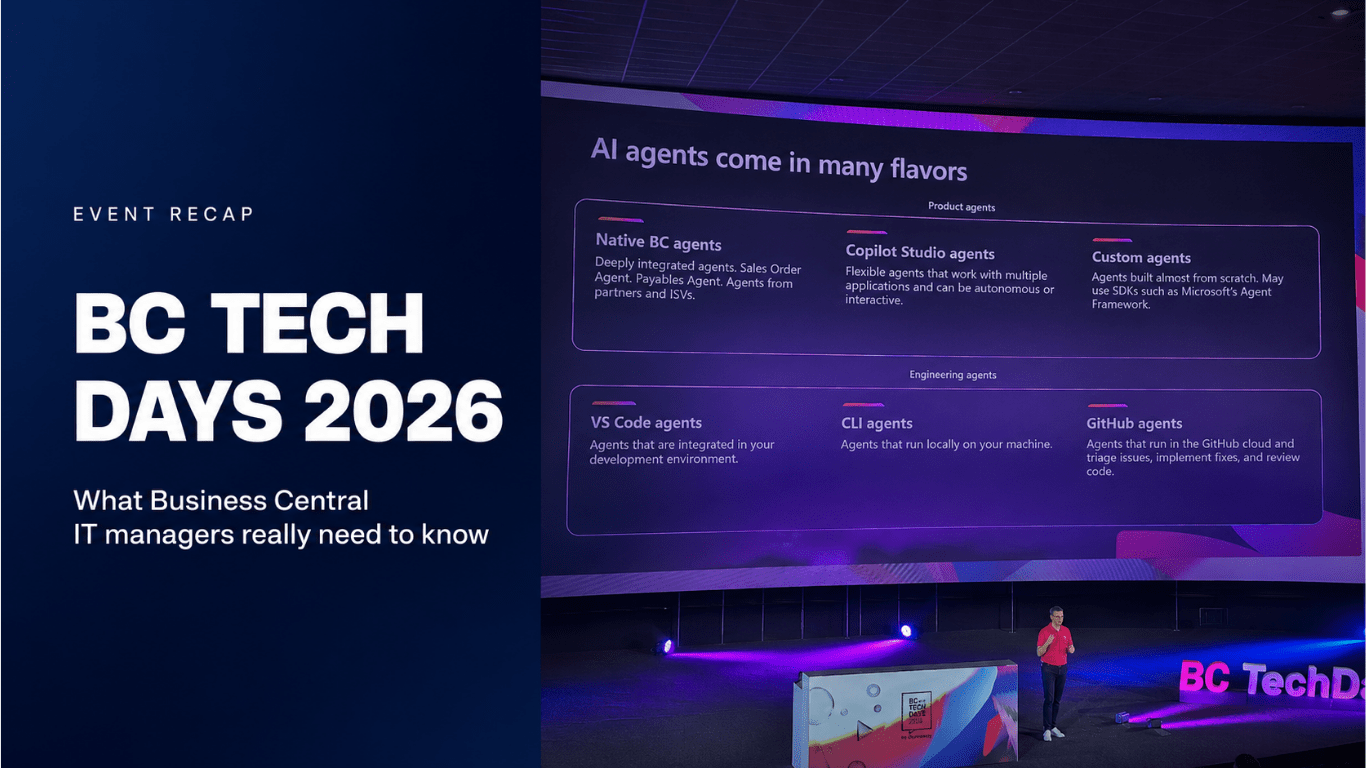

Tech Days 2026 felt different from previous editions. While AI has been a dominant theme for years, this time the focus wasn’t on smarter code suggestions or new programming statements. Instead, the entire first day centered on one core theme: agentic development.
For IT managers working with Microsoft Dynamics 365 Business Central, this shift has direct implications for how customizations, extensions, and integrations will be built in the (near) future.
Normally, a Tech Days event features plenty of demos of AI coding assistants: tools that offer suggestions, improve autocomplete, or generate small snippets of code. This year, the focus shifted entirely to AI agents that independently take over (parts of) the developer’s work. Not as a tool alongside the programmer, but as a replacement for certain tasks within the development process.
For Business Central environments, this means agents will soon not only be able to write AL code, but also run tests, publish extensions to an environment (sandbox or production), and then monitor that production environment for errors or performance issues.
One concept discussed was the so-called telemetry buddy: an agent that monitors a live environment for errors, failures, poor performance, or missing database indexes. When this agent detects a problem, it can then propose code changes to resolve it.
The result is a kind of closed loop: one agent develops and publishes functionality, another tests it, and a third monitors the production environment and feeds improvements back into the development process.
To give agents access to systems, think of a Business Central environment, a test environment, a ticketing system, or source control, a so-called MCP server (Model Context Protocol) is used. This server determines exactly which permissions an agent receives on a given system.
For IT managers, this is an important point of attention: it introduces a new layer of access management and security that must be explicitly set up and monitored. Who decides which agent gets access to a customer’s production environment? And how is this logged and audited?
In addition to access via MCP servers, agents work with tools and skills. Skills are arguably the most important component: this is where developers define how an agent should program, which standards apply, and what best practices are followed.
This can also be applied to documentation, generating test and application documentation in a consistent way, something agents turned out to be remarkably good at.
This is perhaps the most practical takeaway from Tech Days: agentic development makes customization faster and more affordable, and that fundamentally changes how IT managers should think about their Business Central environment.
In the past, custom development had a negative reputation. The investment was high, maintainability was difficult, and documentation often fell short. As a result, customization was frequently avoided, even when the functional need was clearly there. With agents that write, test, and document AL code, that calculation changes fundamentally.
Small adjustments and improvements that were previously too costly can now be implemented quickly. Existing customizations can be enriched with better documentation and cleaned up from known bugs and technical debt. And functionality that was never implemented due to cost is now back on the table. The result: a richer, more stable, and better-documented Business Central environment.
For IT managers, this requires a shift in mindset: no longer “is customization worth it?”, but “which improvements have we been leaving on the table?”
The biggest message from Tech Days 2026: classic programming, including the now-familiar “vibe coding” with AI, will decline or may even disappear over time. The role of the Business Central developer is shifting toward developing skills, tools, MCP integrations, and agents. These agents then largely handle the actual development, testing, and monitoring automatically.
For IT managers, this means a shift in how teams are managed: no longer based solely on code written, but on the quality of the agents, skills, and frameworks they build and on how well they maintain control over what those agents do autonomously.
Receive practical insights about Microsoft Dynamics 365 Business Central, app developments, and product updates directly in your inbox.
Contact us and subscribe via q-teamsolutions.com